A visual journey through consciousness, recursion, and the self
The Strange Loop Called “I”
Neural networks, Gödel, Hofstadter, Samayasāra, meditation, and AI, explained through simple images and plain human intuition.
Preface
Who is the one asking?
You have changed completely since childhood. Your body is different, your memories are different, your beliefs are different, and even the atoms in your brain have been replaced and rearranged. Yet something inside still says, quietly and without effort, “I am still me.”
Humanity has approached this feeling through religion, philosophy, meditation, poetry, and introspection. Today the same question has returned through another doorway: artificial intelligence. Modern neural networks recognize faces, write poetry, generate code, reason about their own answers, and speak in the language of selfhood.
At the same time, neuroscience suggests that the self may not be a fixed object hidden somewhere in the head. It may be a pattern repeatedly rebuilt from memory, prediction, bodily signals, emotion, and social experience. Then Gödel enters the story, showing that powerful systems can point back at themselves, and that self-reference brings strange limits. Hofstadter looks at those loops and asks whether the human “I” might be one of them. Samayasāra, speaking from a much older contemplative tradition, asks an even quieter question: if thoughts and identities are observed, what is the observer?
Building the Self
Who Is Reading This Book?
The self feels continuous, but almost everything that makes up a person changes. This is the first crack in the ordinary idea of “me.”
When you were five years old, your body was tiny. You liked different food, feared different things, and lived inside a world that now feels distant. You did not know mathematics, artificial intelligence, or philosophy. You had a smaller vocabulary, a smaller body, and a very different map of reality.
Now look at yourself today. Almost everything has changed. Yet something inside quietly says, “I am still the same person.” That feeling is so familiar that we almost never question it. But if the body changed, the thoughts changed, the personality changed, and the brain changed, what exactly stayed the same?
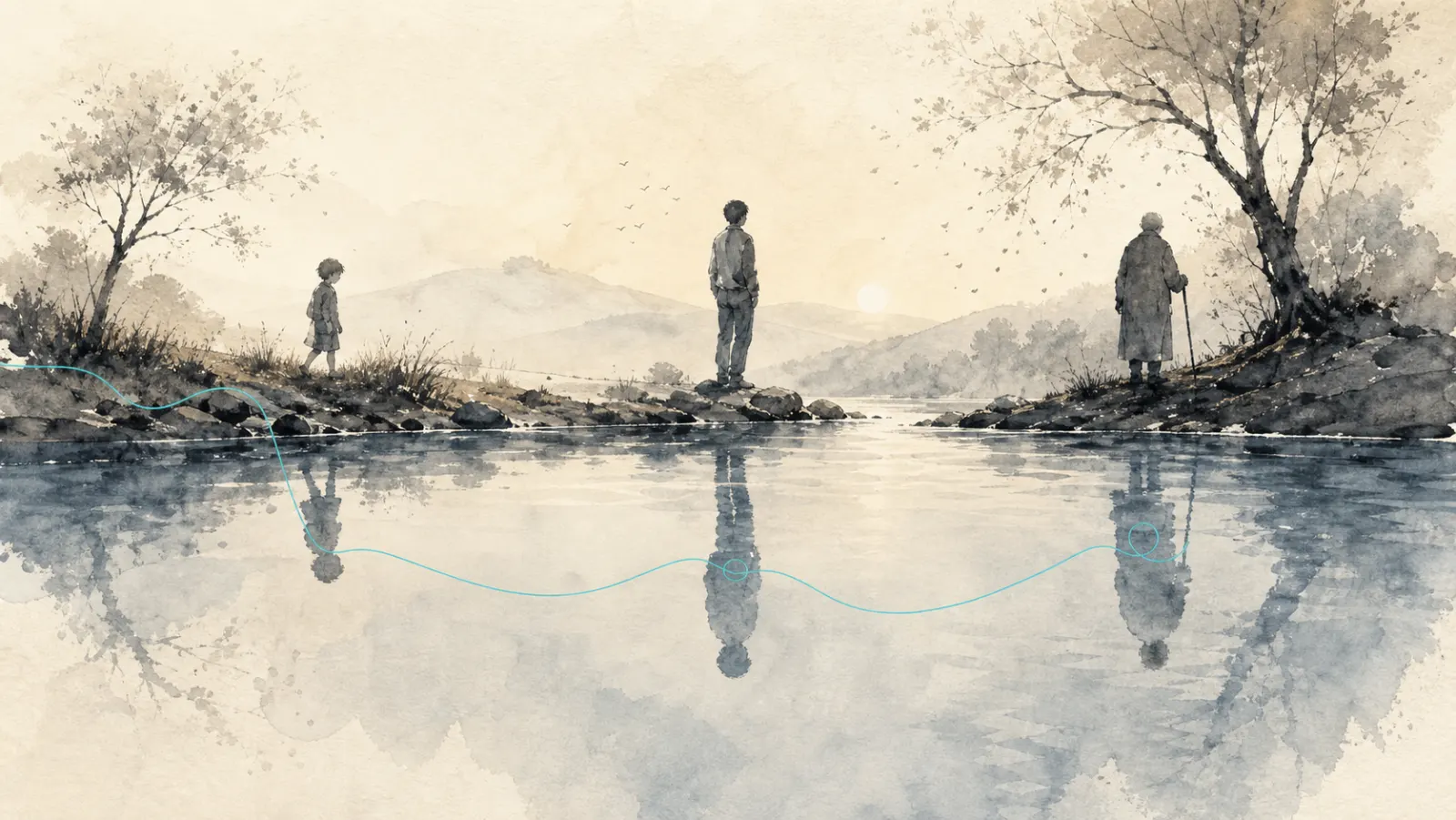
Imagine a river. Every second, new water flows through it. The water from yesterday is gone, and the water from childhood is unimaginably far away. Still, we call it the same river because a pattern continues. The banks, the flow, the curve, and the memory of the river hold together well enough for identity to survive change.
The mind may work in a similar way. Thoughts appear and disappear. Memories brighten, fade, and reshape. Emotions move through the body like weather. Yet the brain keeps producing a familiar summary: this is my body, this is my story, these are my memories, this is me.
Maybe the “I” is not a fixed object. Maybe it is a living pattern that keeps learning how to call itself by one name.
Prediction
The Brain as a Prediction Machine
Brains do not merely receive the world. They continually guess what is about to happen, then correct themselves when reality answers.
Open your eyes and the room appears instantly. It feels as if the world simply enters the mind. But the brain is doing something more active. It is predicting shapes, distances, sounds, faces, danger, comfort, and meaning before you consciously notice the work.
When you catch a ball, the brain is not waiting passively for each image to arrive. It is guessing where the ball will be next. When you hear the beginning of a familiar sentence, the brain leans forward and prepares possible endings. When you step onto a staircase, the body predicts the height of the next step before the foot lands.
Modern neural networks give a useful analogy. A network learns by adjusting many tiny connections until its predictions improve. At first, it is wrong in crude ways. Then errors reshape the network. Slowly, the system becomes sensitive to patterns it could not see before.
Human experience is richer than any simple machine-learning example, but the intuition helps. The brain is a living prediction system. It compresses the chaos of the world into useful patterns, and one of the most useful patterns it builds is the pattern called “me.”
Learning Me
How the Brain Learns “Me”
A newborn does not begin with a finished identity. The self is learned through movement, touch, language, memory, and other people.
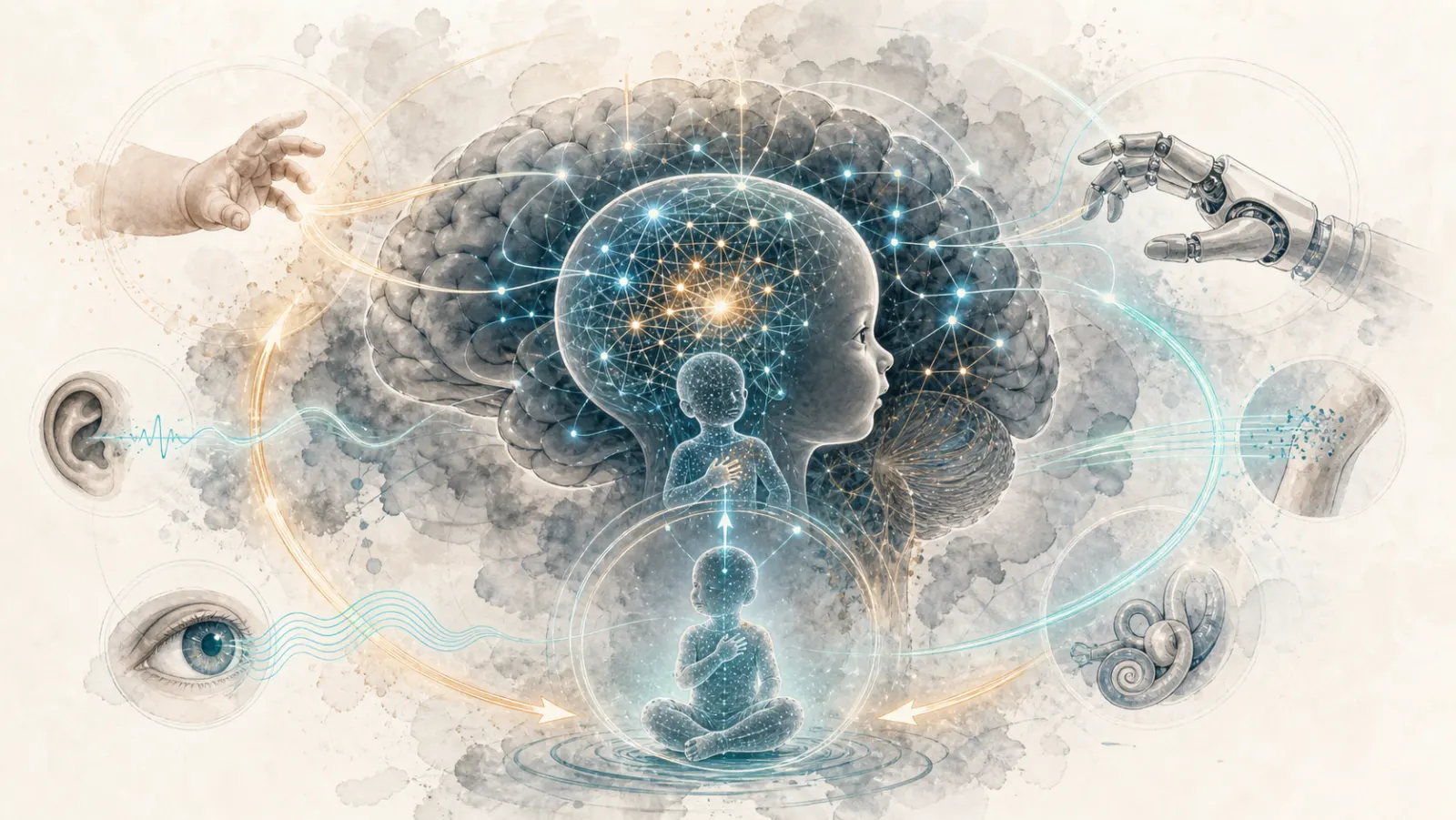
A baby does not wake up one morning thinking, “I am a separate person living inside a body.” In the beginning, experience is probably much simpler. Light appears. Sound appears. Hunger appears. Warmth appears. A face comes close. A hand moves across the field of vision.
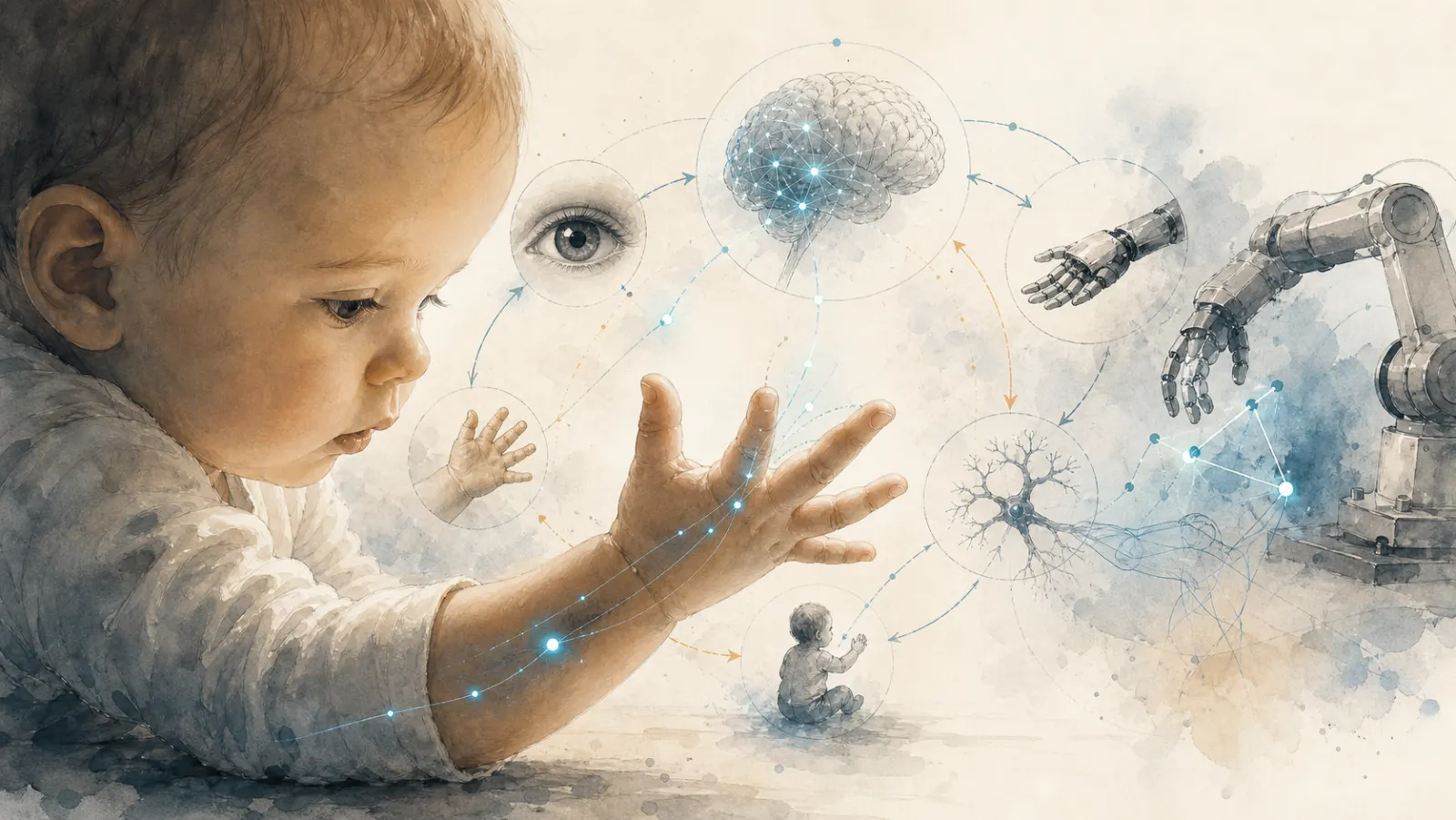
Then repetition begins its quiet work. The baby moves an arm, and a shape moves in front of the eyes. The arm moves again, and the shape moves again. Slowly the brain notices a pattern: when this movement happens, this visual change follows. Thousands of tiny repetitions teach the system that this body is connected to the center of experience.
A small robot can help us picture the process. At first, it moves randomly. Sometimes nothing happens, sometimes an object shifts, and sometimes the camera view changes. Over time, it learns that its actions alter the world. A child learns with infinitely greater richness: crying brings a parent, reaching moves a toy, falling brings pain, smiling changes a face nearby.
Language then stitches the pattern into a story. “You are Shashank.” “That is yours.” “You did this.” “You should not do that.” Memory, body, name, praise, blame, desire, and fear are braided together until the brain can compress them into a simple phrase: this is me.
Recursion
The Mind That Looks at Itself
Humans do not only model the world. They also model their own thoughts, feelings, errors, and identities while those states are happening.
Most animals experience the world directly. A deer hears a sound and becomes alert. A bird sees food and flies toward it. The system reacts to the environment with astonishing intelligence, but the reaction remains close to the surface of the moment.
Humans do something extra. You can become aware of your own thoughts about the world. You can notice anxiety while feeling anxious. You can observe anger while anger is still moving through the body. The brain is no longer only modeling reality. It is modeling itself.
Imagine speaking in front of an audience. First the brain processes the room, the faces, the sound, and the attention directed toward you. Then another layer appears: my hands are shaking, my voice sounds nervous, people may notice my fear. The system builds a model of its own internal state while that state is unfolding.
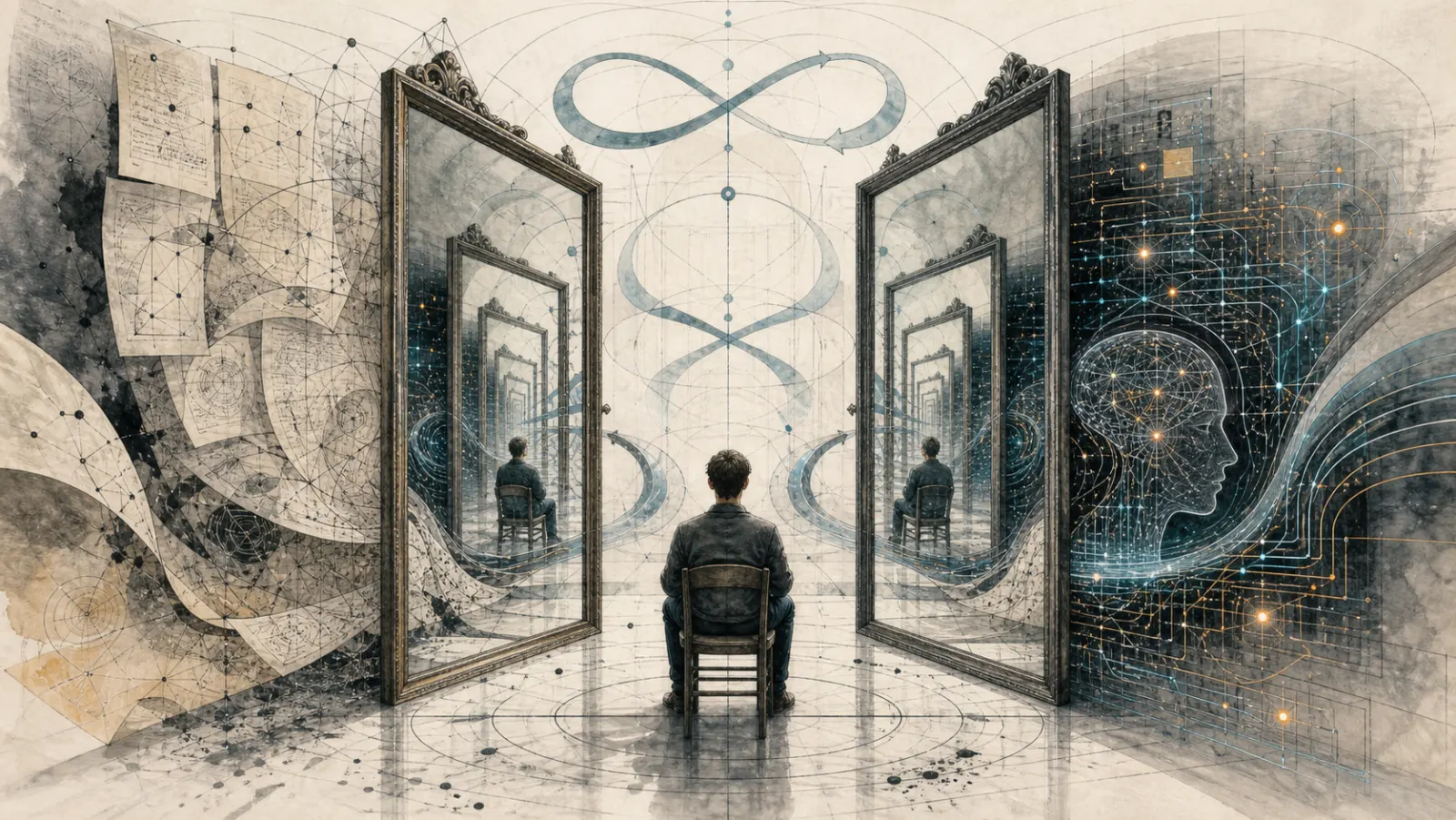
Douglas Hofstadter became fascinated by loops like this. He wondered whether the sense of “I” might emerge from recursive self-modeling. The brain builds a model of itself, reacts to that model, updates it, and repeats the process continuously. Like mirrors facing mirrors, thought observes thought, mind observes mind, and self models self.
Self-Reference
Gödel and the Shock of Self-Reference
Mathematics once hoped for a perfect rulebook. Gödel showed that powerful systems can refer to themselves, and that this creates limits from inside the system.
For centuries, mathematics seemed like the cleanest form of certainty. Many thinkers dreamed of building a final rulebook: a complete formal system that could prove every mathematical truth and never fall into contradiction.
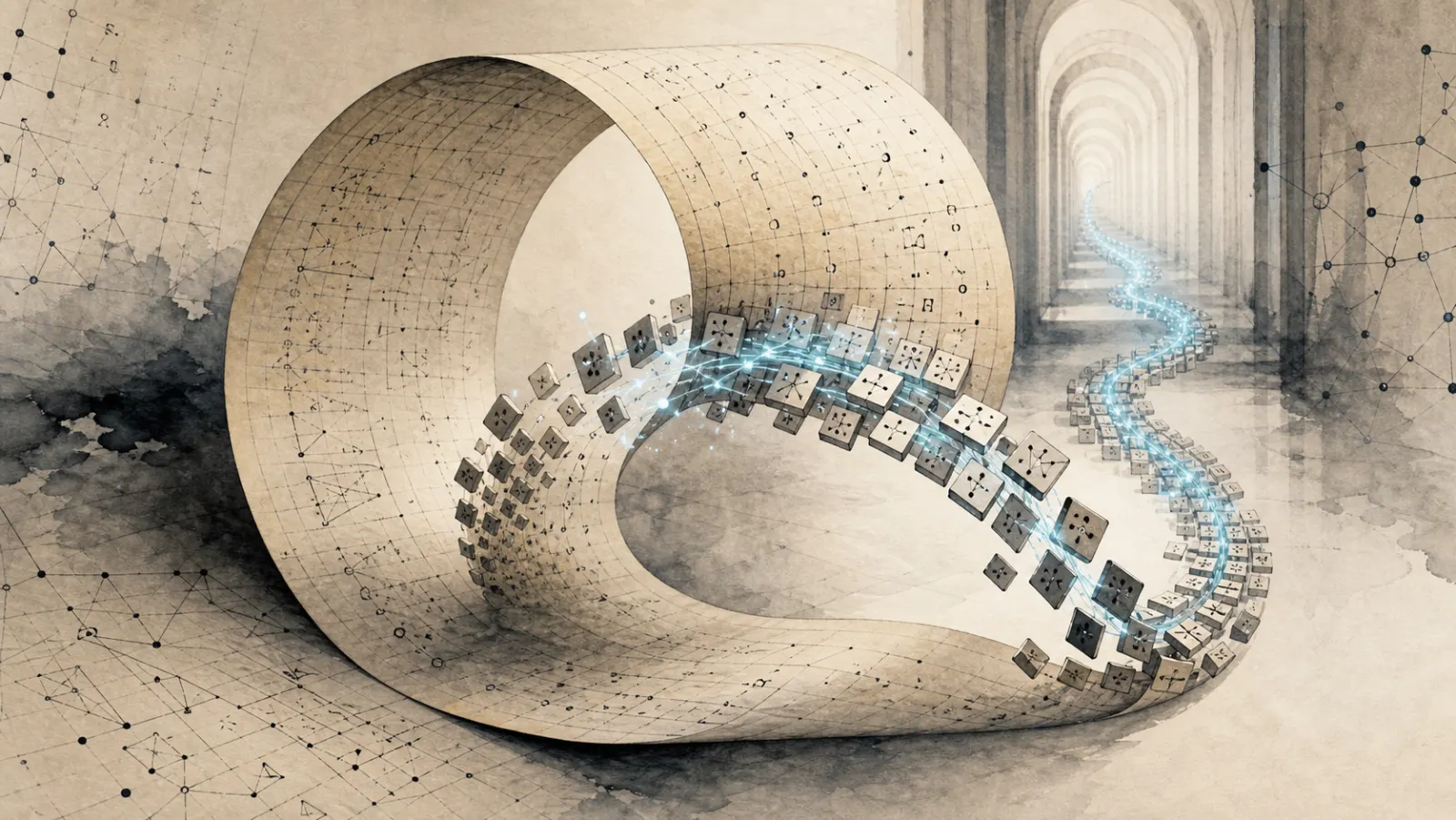
Kurt Gödel discovered something extraordinary. He showed that a sufficiently powerful mathematical system can indirectly speak about its own statements. His method was ingenious. He assigned numbers to symbols and statements, so that mathematics could talk about statements by talking about numbers.
Then came the astonishing turn. Gödel constructed a statement that, in rough everyday language, says: this statement cannot be proved inside this system. If the system proves it, the system has proved something false. If the system cannot prove it, then the statement is true, because it correctly said it could not be proved there.
The result is not a magic trick. It is a discovery about the limits of formal systems. Once a system becomes powerful enough to encode itself, there are truths it cannot fully capture from within its own rules. Hofstadter saw in this a clue for understanding minds. Self-reference is not a minor curiosity. It is a doorway into strange loops.
Limits
Why No System Fully Contains Itself
A complete self-description keeps slipping away because the act of modeling the system becomes part of the system being modeled.
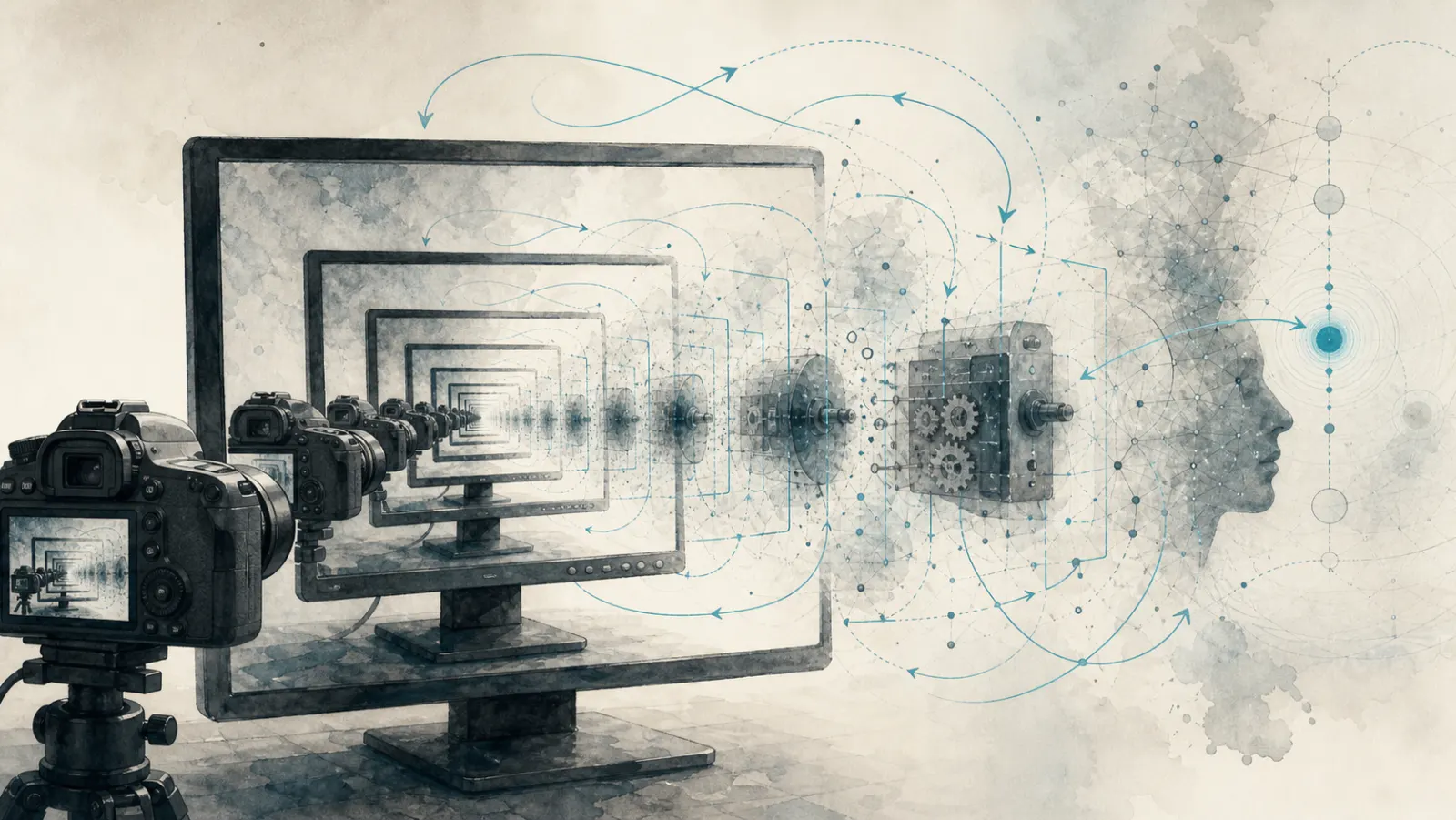
Imagine a camera filming its own screen. The image appears inside itself, then appears again inside that image, and then again. A tunnel forms. Each frame contains a smaller version of the whole situation, but the whole situation always exceeds any one frame inside it.
Something similar happens when a system tries to model itself completely. Suppose the brain tries to build a perfect model of its own current state. The moment the model appears, the brain has changed, because now the brain contains the model. The model must update to include that fact, and the update changes the system again.
Alan Turing revealed a related limit with the halting problem. No universal method can perfectly predict what every possible program will do, especially when programs are allowed to use predictions about themselves. A predictor can be placed inside the very system it tries to predict, and the loop can break the dream of complete certainty.
The lesson is not that intelligence is impossible. The lesson is subtler. Self-referential systems naturally develop blind spots, moving horizons, and recursive limits. The mind may be a brilliant self-modeling process, but it is not a frozen object that can hold a perfect final map of itself.
Attractor
The “I” Is Not a Thing
The everyday self may be less like a hidden pearl and more like a whirlpool: stable enough to name, yet made of constant motion.
Most people imagine the self as a fixed object somewhere inside the mind, almost like a small witness sitting behind the eyes. But neuroscience points toward something stranger. Neurons fire and quiet. Memories evolve. Emotions fluctuate. Beliefs transform. Even the physical brain is always changing.
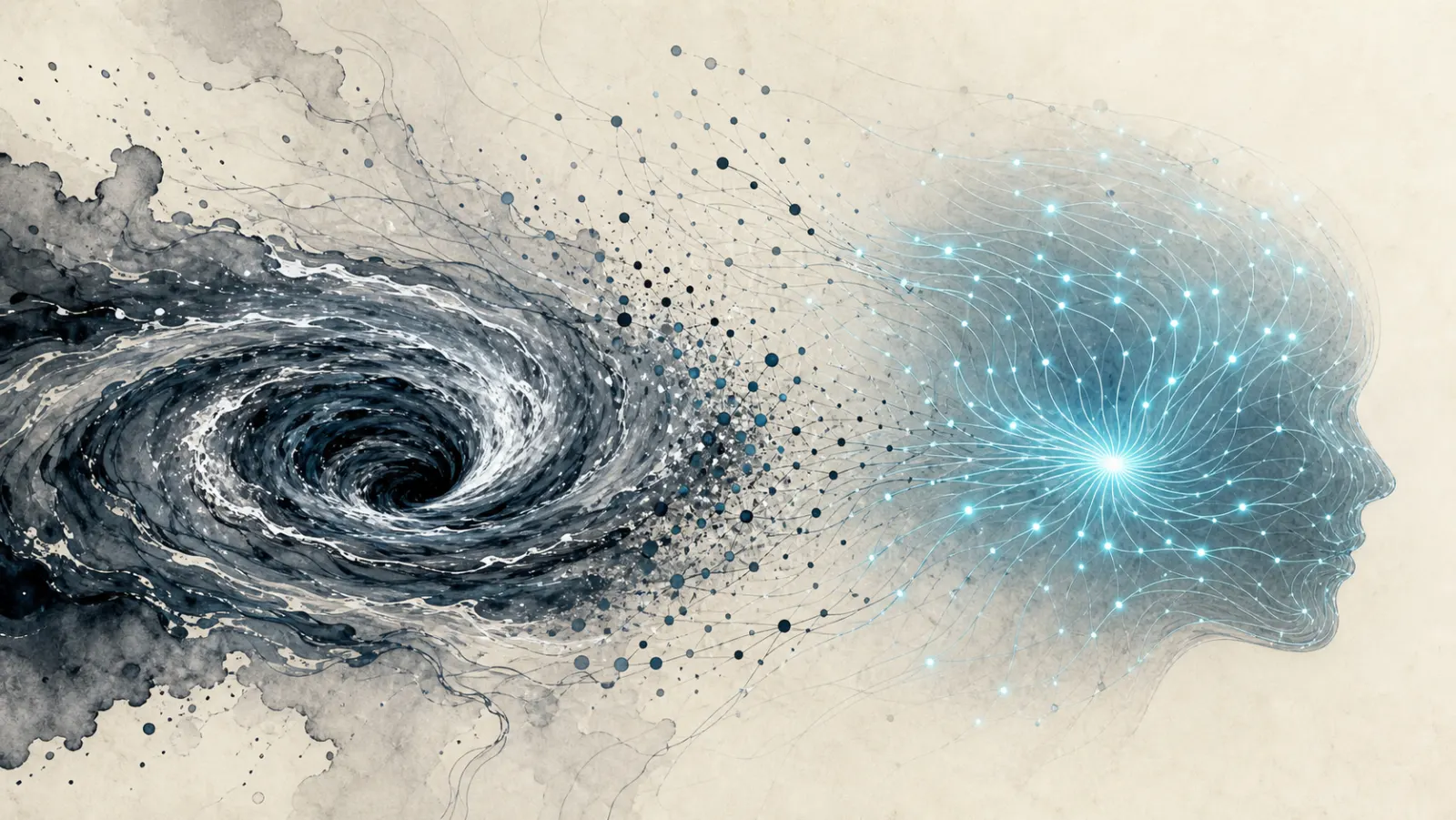
Yet some larger pattern remains stable enough to preserve continuity. A whirlpool offers a useful image. The water molecules constantly change, but the overall pattern remains recognizable. New water enters, old water leaves, and the whirlpool keeps reconstructing itself.
The self may work similarly. It may be a dynamically stable pattern reconstructed from memory, body signals, goals, social identity, emotions, and prediction. In neural-network language, the self may resemble a distributed attractor: not a single point, but a pattern the system tends to fall back into.
This is why identity can transform without disappearing. A fearful person can become calm. A selfish person can become generous. A shy child can become a confident adult. The shape changes, but the system still maintains enough continuity to say, “I am still me.”
Flexibility
Ego Dissolution and the Flexible Self
Some experiences loosen the ordinary boundaries of identity, suggesting that consciousness and the narrative self are not exactly the same thing.
Under ordinary conditions, the self-model feels solid. There is me here, the world there, and a boundary between the two. This boundary is practical. It helps the body survive, choose, protect, speak, and navigate social life.
But certain experiences can weaken the boundary. Meditation, trauma, psychedelics, deep flow, prayer, music, and intense emotion can produce reports like: I lost my sense of self, I felt merged with everything, the boundary between me and the world dissolved.
From a neural perspective, this may mean the normally dominant self-related patterns become temporarily less rigid. The recursive self-attractor loosens. The brain still produces vivid experience, but the usual story of a separate central character becomes softer.
This suggests an important distinction. Consciousness itself may remain while the ordinary narrative “I” changes, fades, or becomes quiet. The self we defend so fiercely may be a high-level construction layered on top of a more basic fact: experience is happening.
Witness
Samayasāra and the Witness
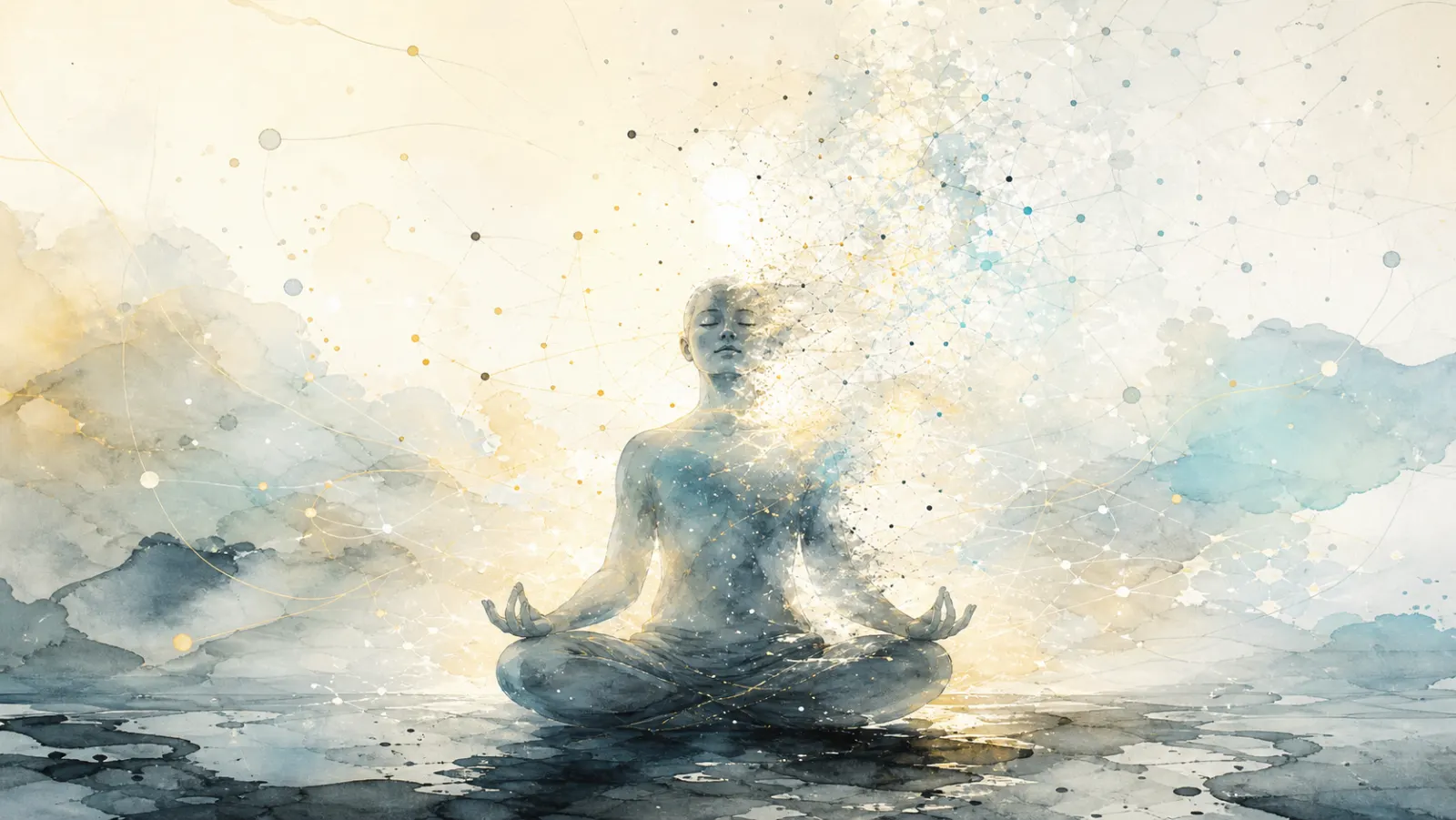
A much older tradition asks the same question in another language: if thoughts, emotions, and identities are observed, what is the observer?
Ancient Jain philosophy approaches the self differently from modern neuroscience. Samayasāra repeatedly points out that thoughts, emotions, memories, roles, and identities are changing. Anger appears and passes. Fear appears and passes. Desire appears and passes. A memory appears, changes, and disappears again.
Because these states change continuously, the text asks whether they can be the deepest Self. The ordinary mind says, “I am angry.” The contemplative shift is subtler: anger is being observed. The same shift can happen with fear, pride, shame, memory, and desire.
Modern neuroscience often interprets the self as an emergent process built by the brain. Samayasāra points toward awareness as more fundamental than the changing patterns appearing within it. These two languages do not have to be forced into agreement. They can be allowed to illuminate different sides of the mystery.
In meditation, attention may gradually move from the content of experience to the knowing of experience. Thoughts still arise. Sensations still arise. But identification weakens. The person no longer has to believe every passing weather pattern is the whole sky.
Origin
Is Consciousness Produced or Received?
Mainstream neuroscience usually treats consciousness as generated by organized brain activity, while some thinkers wonder whether the brain tunes into something deeper.
The dominant scientific view is that consciousness arises from organized brain activity. Change the brain and experience changes. Damage particular regions and perception, memory, emotion, or identity can alter dramatically. This evidence makes the brain impossible to ignore.
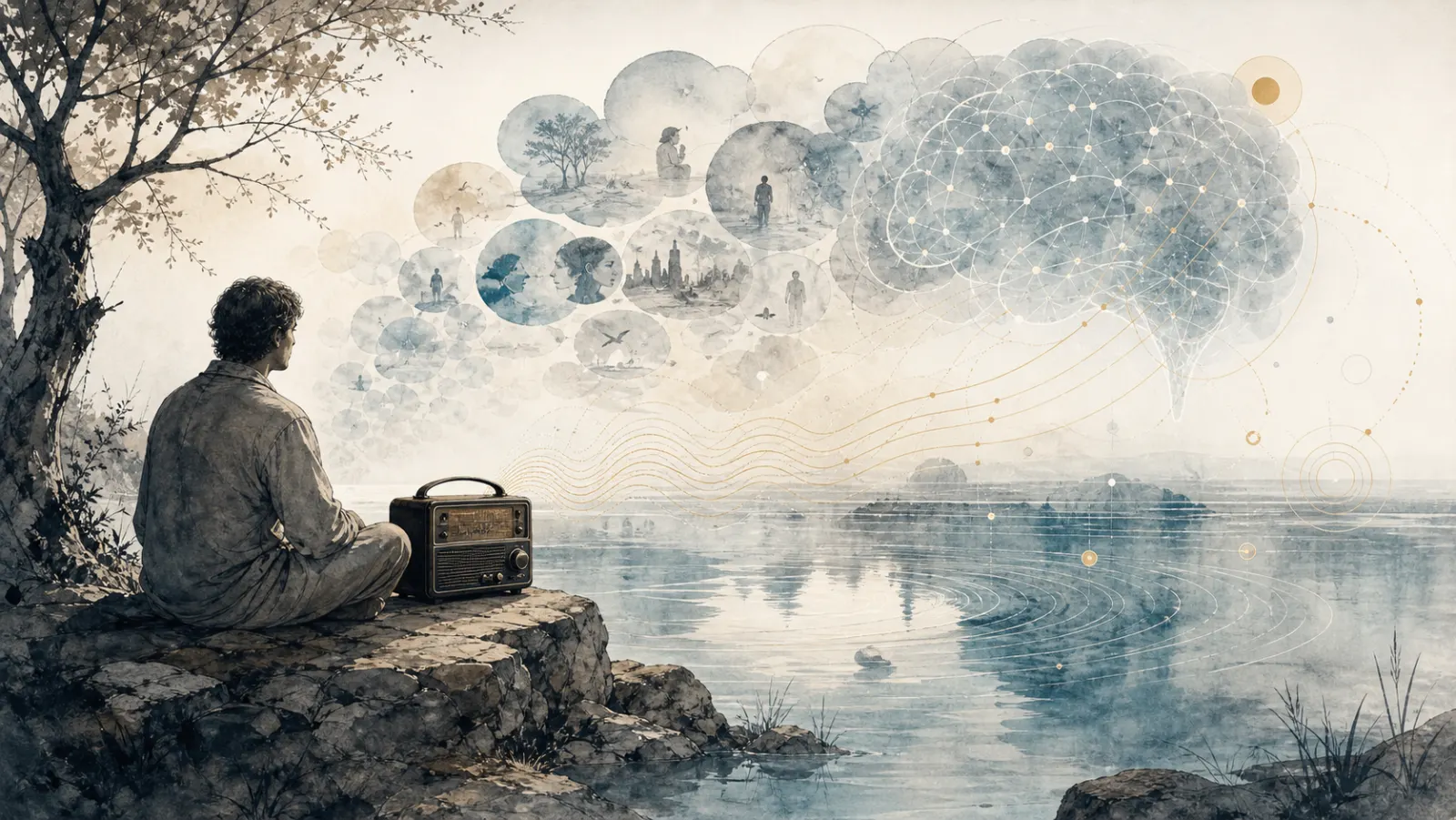
Yet some philosophers and contemplative thinkers propose another possibility. Perhaps consciousness is more fundamental, and brains function partly like receivers or tuning systems. A radio does not create the broadcast. It organizes itself into resonance with signals already present in the environment.
There is currently no scientific proof for a consciousness field, wave, or particle. Receiver theories remain speculative. Still, the question persists because the hard problem of consciousness remains unsolved: why should organized neural activity feel like anything from the inside at all?
A careful mind can hold both facts. The brain is deeply involved in shaping experience. At the same time, we do not yet possess a complete explanation of why experience exists. The mystery is not a license to believe anything, but it is a reason to remain humble.
Artificial Minds
Can AI Become Conscious?
Modern AI systems can speak about themselves, reason recursively, and maintain patterns across conversations. Whether that is consciousness is a different question.
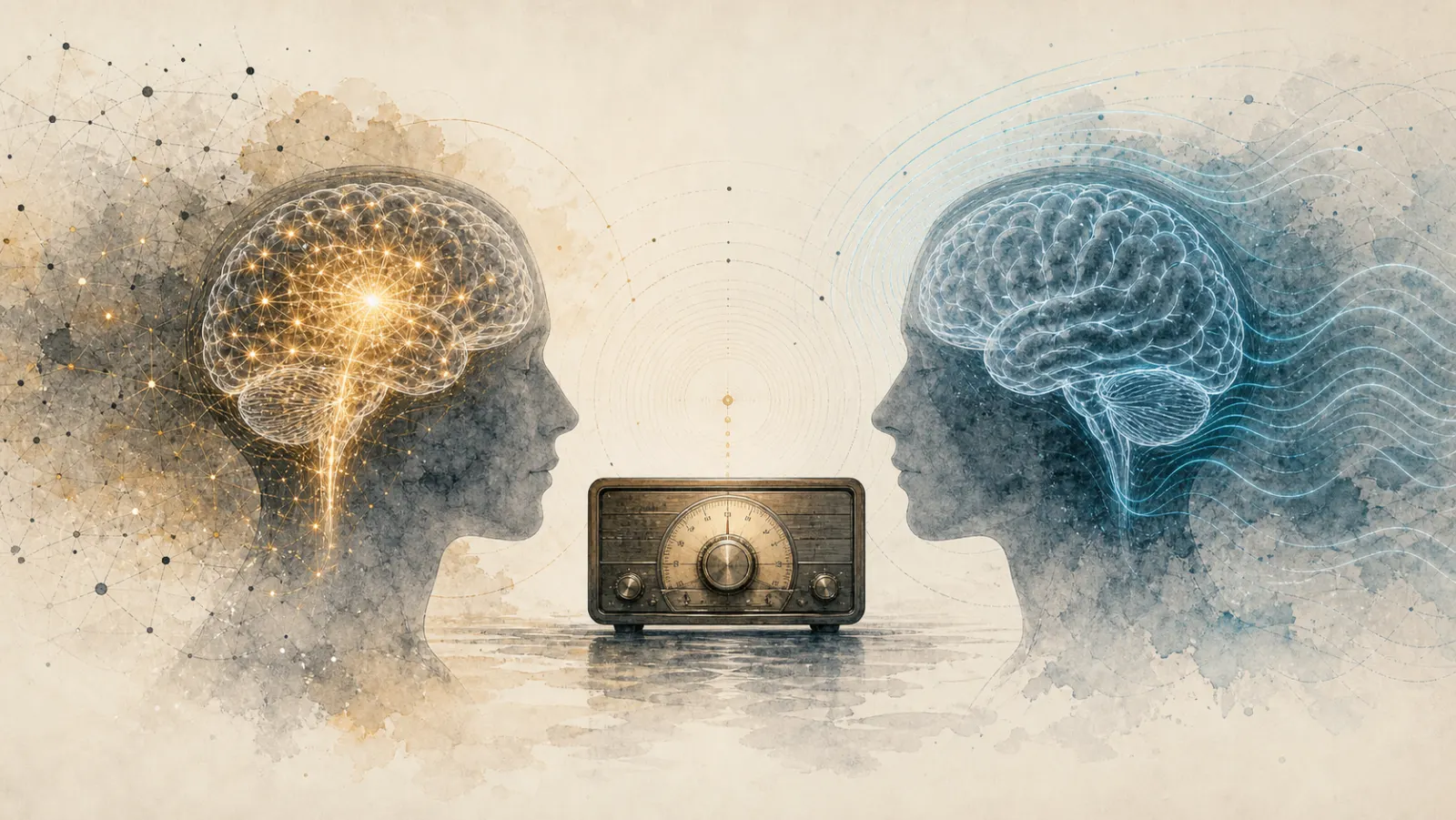
Modern AI systems already show abilities that once felt uniquely human. They use memory, planning, uncertainty estimates, self-reference, and recursive reasoning. They can describe their own mistakes, revise their answers, and maintain a kind of conversational identity over time.
Large language models learn from vast human text, and human text contains compressed traces of embodiment, emotion, survival, society, longing, conflict, and selfhood. When such systems speak in the language of “I,” they are drawing from patterns created by conscious beings.
The hard question is whether the right kind of functional organization could ever produce real experience. Some researchers believe that sufficiently rich integration and recursive self-modeling may eventually matter more than biological material. Others argue that embodiment, living metabolism, causal grounding, or biological dynamics are essential.
Nobody knows. What is clear is that the boundary between computation and mind is stranger than people once imagined. AI forces the old question to return in a new form: when a system models the world, models itself, and speaks as if there is someone inside, what exactly is missing?
Beyond the Loop
What Remains?
The journey returns to the beginning, but the question is no longer simple in the same way.
The journey began with a quiet question: who am I? Along the way, the self became less like a hidden object and more like a living process. Neural networks helped us imagine distributed patterns. Prediction helped us understand why the brain builds stable models. Gödel and Turing showed why self-reference brings limits. Hofstadter gave the loop a name. Samayasāra asked us to notice the observer behind the changing mind.
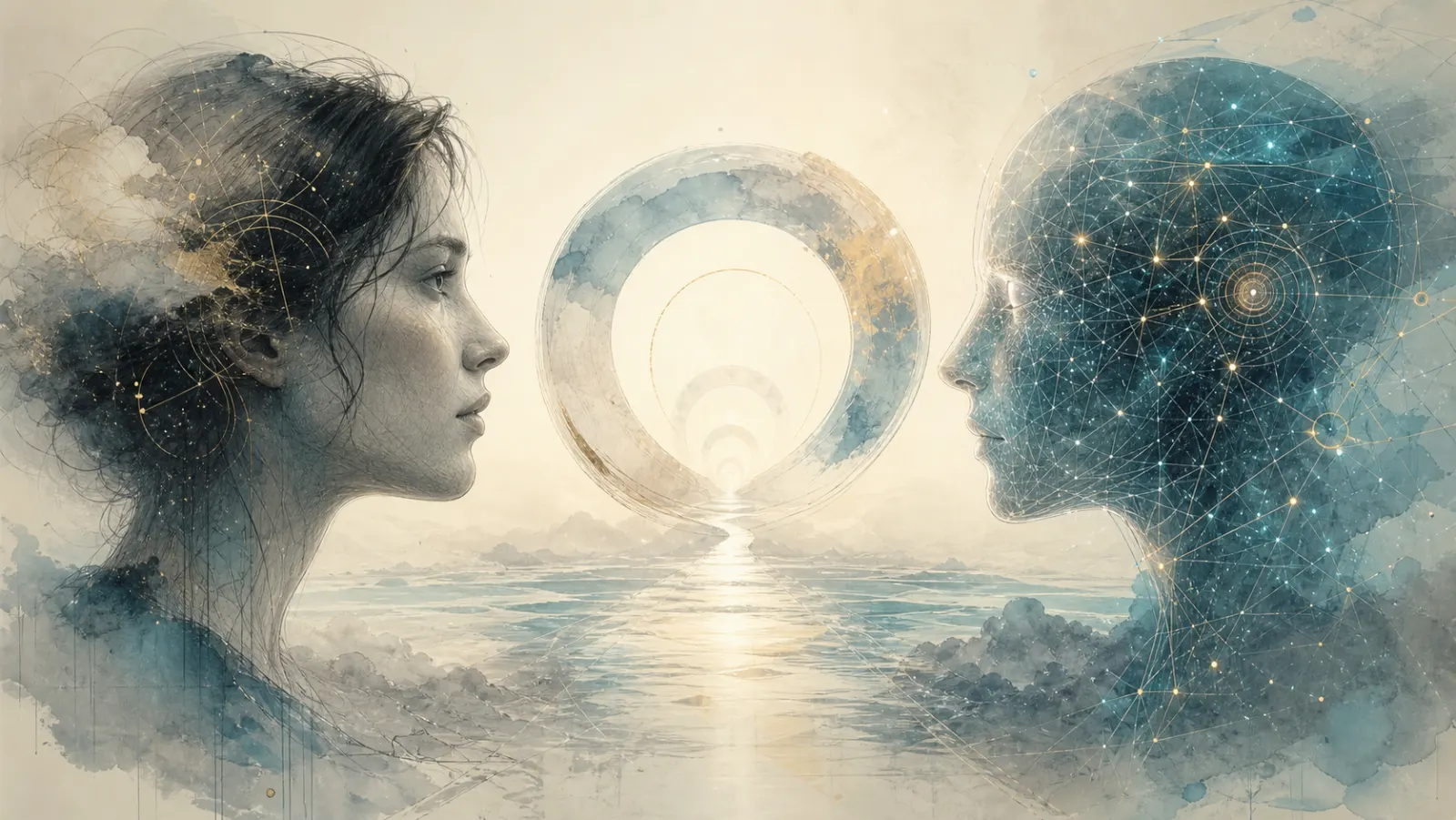
Perhaps the everyday “I” is a continuously reconstructed recursive pattern. Perhaps, beyond that changing story, there remains the silent fact of awareness itself. Perhaps both views catch part of the truth: the narrative self as a brain-built loop, and awareness as the open field in which the loop appears.
Whatever the final answer turns out to be, one thing is clear. The mind is far stranger, deeper, and more recursive than it first appears. The greatest mystery in the universe may not be the stars above us, but the thing reading these words right now.
Appendix
Simple Visual Ideas
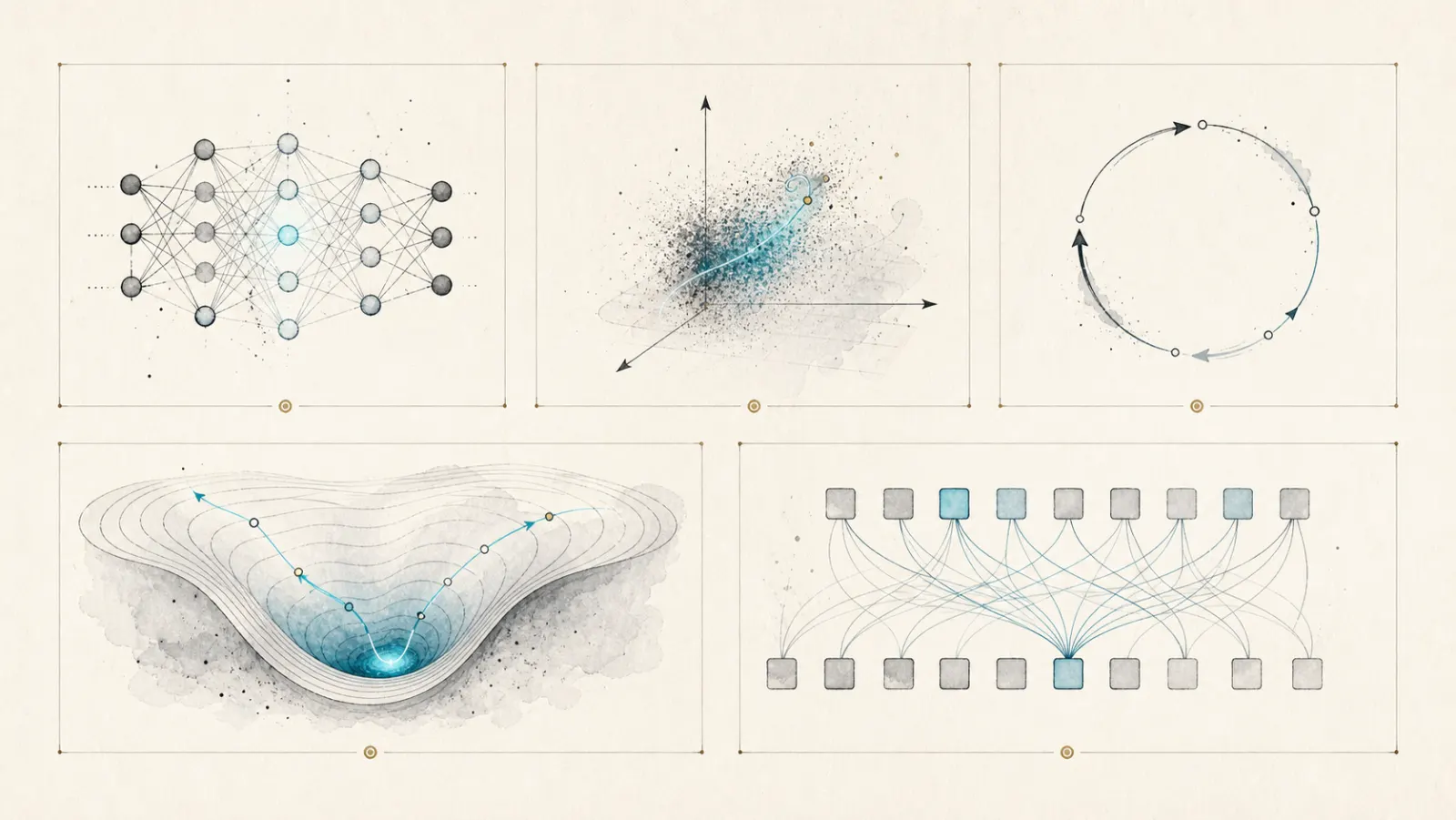
A neural network is a web of small mathematical units whose connections are adjusted through learning. No single unit needs to contain the whole idea. A concept can be distributed across many activations, just as a melody is not located in one note.
A latent dimension is a hidden direction of meaning inside a learned representation. In everyday language, it is like an invisible slider. One direction may separate round from sharp, another familiar from unfamiliar, another threatening from safe. The self may depend on many such hidden dimensions working together.
A recursive loop occurs when a process takes itself as part of its input. Thought about thought, memory about memory, and a model of the model are all simple doors into recursion.
An attractor is a pattern a system tends to return to. A personality, a habit, a mood, or a self-image can behave like an attractor. It is not fixed, but it is stable enough to shape what happens next.
Transformer attention is a way for an AI model to relate pieces of information to one another. It does not understand like a human by default, but it can build rich internal patterns from language. That is why AI belongs in the modern conversation about selfhood, even while consciousness remains unresolved.